HVAC Sizing and Manual J in Santa Clarita
Plainly put: Right-sizing HVAC in Santa Clarita means running a Manual J load that anchors the BTUs to your actual house, not the old nameplate; Santa Clarita Trane HVAC does precisely that from Valencia (91354) through the two-story Tesoro del Valle tracts, so call (213) 755-2539 or book online. Oversized equipment short-cycles and wears out early in 95 F valley heat, while a right-sized unit runs longer and lasts longer.
What to know
- Manual J is the trade-standard load calc; it matches equipment to your house, not a per-square-foot shortcut.
- Oversize and you inherit short cycling, poor dehumidification, uneven rooms, and faster wear.
- Many two-story valley homes calculate smaller than the oversized unit already sitting outside.
- Under 45,000 BTU, split ACs must meet the Southwest-region floor of 14.3 SEER2 / 11.7 EER2.
- Title-24 in Zone 9 requires charge and airflow verification, plus HERS the moment ducts are altered.
- Independent; serving Santa Clarita ZIPs 91350-91390.
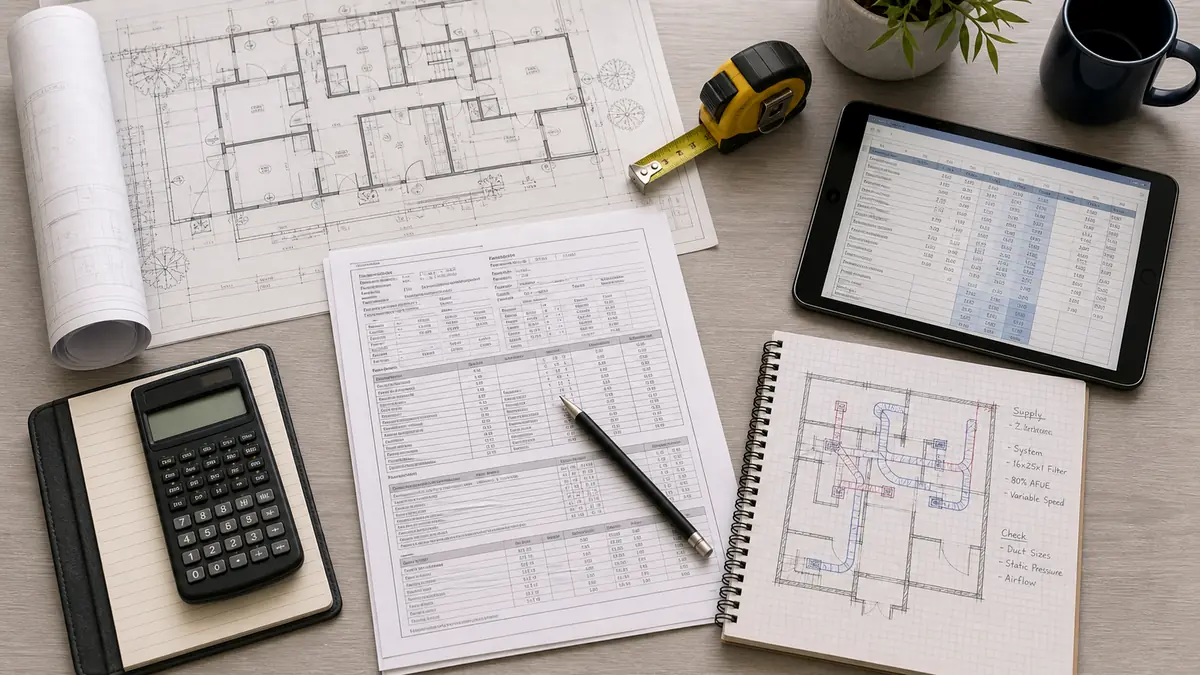
Why does sizing matter so much here?
Santa Clarita falls inside Title-24 Climate Zone 9, sitting above the LA basin where summers turn hotter and drier, the night-to-day swing is wide, and the calendar piles up 55 to 75 days a year over 90 F. A load that punishing tempts both homeowners and drive-by bidders into buying a bigger box, which is exactly backwards for this climate. An oversized AC drives the air cold, clips the thermostat setpoint, and quits before it has run long enough to pull out humidity or even out the upstairs. Minutes later it cycles on again. That pattern hammers the Climatuff compressor and the capacitor and never returns the efficiency you paid for. On any replacement, dialing in the correct size is the single most valuable thing we do.
What goes into a Manual J load?
A genuine load calculation is built around your specific house. We measure conditioned square footage, the area and orientation of the glass (west and south windows drive the afternoon load out here), ceiling height, attic and wall insulation, air infiltration, and the design temperatures for our zone. Duct condition counts as well, since leaky or undersized runs shift the effective load. What comes out is a BTU number, convertible to tons, that the equipment should track closely rather than overshoot by a comfortable cushion.
| Input | Why it matters in Santa Clarita |
|---|---|
| West / south glass area | Afternoon solar gain dominates the valley cooling load |
| Insulation and attic condition | 140 F attics make insulation quality decisive |
| Square footage and ceiling height | Two-story tract volume, not a flat per-foot rule |
| Duct leakage and return size | Leaky returns inflate the apparent load |
| Infiltration / air tightness | Affects both heating and cooling demand |
What size do Santa Clarita homes usually land on?
Smaller than people expect. It is common to walk into a two-story Valencia or Tesoro del Valle tract home carrying a 5-ton unit and have the Manual J return 3.5 or 4 tons once the actual glass, insulation, and duct condition are accounted for. The original builder sizing was often a rule-of-thumb overshoot. Correcting that to a right-sized unit, paired with sealed ducts, gives steadier temperatures, better humidity control, quieter operation, and a longer equipment life. The table below is a rough orientation only; your real number comes from the calculation.
| Home | Common existing | Often calculates to |
|---|---|---|
| Single-story Newhall ranch | 3 - 3.5 tons | 2.5 - 3 tons |
| Two-story Valencia tract | 4 - 5 tons | 3.5 - 4 tons |
| Larger Tesoro / Valencia Summit home | 5 tons | 4 - 4.5 tons |
A worked sizing example for a Valencia tract home
Walk through how the numbers actually land, using an illustrative composite of a two-story 2,200-square-foot Valencia production home. The rule-of-thumb crowd grabs the old square-foot shortcut, roughly 400 to 600 square feet per ton, and lands on a 4-to-5-ton unit, which is exactly what the builder bolted on in the 1990s. Now run the load properly. The home has good attic insulation from a recent re-roof, dual-pane windows, but a wall of west-facing glass that bakes from 2 p.m. on, and attic duct runs measured at meaningful leakage. The Manual J weighs the design temperature, the solar gain through that west glass, the envelope, and the duct losses, and returns roughly 42,000 to 46,000 BTU, about 3.5 to 4 tons. Seal the leaky ducts first and the load drops further, because the system no longer has to overcome air bled into a 140 F attic. So the honest answer is 3.5 to 4 tons, not the 5 tons sitting outside, and the smaller right-sized unit costs less to buy and runs longer per cycle.
| Method | What it uses | Result |
|---|---|---|
| Square-foot rule of thumb | Floor area only, ~400-600 sq ft/ton | 4 - 5 tons (oversized) |
| Nameplate match | Copies the old builder unit | 5 tons (carries the old error) |
| Manual J load | Glass, orientation, insulation, ducts, design temps | 3.5 - 4 tons (right-sized) |
What actually goes wrong when a unit is oversized?
Treating extra tonnage as a cushion backfires in this valley, because every downstream problem with an oversized unit traces to one root: the cycles are too short. The compressor hits the thermostat target inside a few minutes, drops out, and fires again soon after, so the system never stays on long enough to handle the work that depends on sustained airflow:
- Poor dehumidification: a coil that only runs in brief bursts never sustains the cold surface needed to wring moisture out, so the air feels clammy even at a cool setpoint.
- Uneven rooms: short cycles do not move conditioned air long enough to reach the far upstairs bedrooms, so the thermostat room is comfortable while others bake.
- Accelerated wear: every restart is a high-inrush event that overheats the Climatuff compressor and pits the contactor and capacitor, and in valley heat the compressor gets no cool-down between cycles.
- Lost efficiency: a system spends its least efficient seconds at startup, so a unit that is constantly starting never delivers the SEER2 on its label.
- Comfort complaints that get misread as undersizing, tempting a second oversizing mistake.
A right-sized unit avoids the whole chain by running longer at a steadier output, which is exactly what a variable-speed system is built to do.
How does SEER2 and Title-24 fit in?
The federal Southwest-region floor is the strictest in the country: it holds split ACs under 45,000 BTU to 14.3 SEER2 with 11.7 EER2, while split heat pumps must reach 14.3 SEER2 alongside 7.5 HSPF2. Stack California's Title-24 over that, the 2022 Energy Code carried forward through the 2025 cycle, and in our zone it requires refrigerant-charge and airflow verification on every new or replacement split system, with HERS field verification of duct leakage added whenever ducts are altered. Because those triggers key off CEC reference weather stations rather than city lines, we confirm what applies by your street address. Here is the catch: only a correctly sized system with sealed ducts can actually hit that verified airflow, which is why sizing and compliance prop each other up. Before you rely on any compliance claim, check the current code cycle and the exact triggers for your equipment class.
How do ducts change the size you need?
Ducts and sizing are one problem, not two. The Manual J load includes duct losses, so a leaky, undersized attic system in a two-story Valencia or Tesoro del Valle home inflates the BTU number you appear to need. Air bled into the 140 F attic before it reaches the registers reads as extra load, which is one more way homeowners get steered into a bigger box. Seal and right-size the ducts first and the calculated load often drops by a half-ton or more, which can move you from a 4-ton unit to a 3.5-ton unit, saving on both the equipment and the operating bill. Undersized returns are the other half: a variable-speed ECM blower fighting a too-small return runs up the external static pressure, gets loud, and cannot hit its rated airflow, which Title-24 then requires us to verify. That is why we assess the return and trunk sizing as part of the load, not after it.
Bottom line: the sizing checklist
Before you accept any replacement quote in Santa Clarita, make sure the contractor did these:
- Ran a full Manual J on your house, not a square-foot rule of thumb or a copy of the old nameplate.
- Measured the west- and south-facing glass, since afternoon solar gain drives the valley cooling load.
- Assessed attic and wall insulation and the design temperatures for Climate Zone 9.
- Inspected duct leakage and return sizing, and factored sealing into the load.
- Sized to the load, accepting that many two-story tract homes calculate to 3.5 to 4 tons, not 5.
- Planned for Title-24 charge and airflow verification, plus HERS if ducts are altered.
If a bidder skips the load calc and quotes a tonnage off the old unit, that is the moment to get a second opinion.
How do we run your sizing?
We measure the home, assess the ducts, and run the Manual J, then match Trane equipment to the result, from a single-stage XL through a variable-speed XV20i. If the ducts are leaking or undersized we factor in duct repair, since fixing them can lower the load and let you install a smaller, less expensive unit. Sizing is step one of any AC installation or heat pump conversion we do, and it directly affects the repair-or-replace decision.
Common questions
What is a Manual J load calculation?
Manual J is the procedure the trade universally treats as the benchmark for nailing down exactly how much heating and cooling a given house calls for. You feed it square footage, the size and compass direction of the glass, ceiling height, insulation, air leakage, and the design temperatures for your area, and out comes the BTU load the equipment needs to match. That is the honest path to a correctly sized system, not guessing off square footage or just transcribing whatever the old nameplate claimed.
Why is a bigger AC not better?
An oversized AC blasts the air cold, reaches the thermostat target, and shuts off before completing a cycle, then restarts a few minutes later. That short cycling leaves humidity in the air, uneven temperatures room to room, and a compressor and capacitor worn out ahead of schedule. In Santa Clarita's heat the winner is the right-sized unit that runs longer at a softer output, more comfortable and longer-lived.
How many tons does my Santa Clarita home need?
It depends on the specific home, not a rule of thumb. Many two-story valley tract homes that have a 5-ton unit actually calculate to 3.5 or 4 tons once west-facing glass, insulation, and duct condition are measured. We run the Manual J rather than assume; the correct answer is whatever the load math returns for your house.
Does Title-24 require airflow verification on a new system?
Yes. Drop a new or replacement split system into Climate Zone 9 and you set off refrigerant-charge and airflow verification, and the instant you touch the ducts you add HERS duct-leakage verification on top. A system only hits that verified airflow when the size is correct and the ducts behind it are tight, so getting the sizing right and clearing code are really two parts of one job.
Last updated 2026-06-13.