Trane AC Repair in Santa Clarita
Plainly put: Santa Clarita Trane HVAC repairs Trane air conditioners across Santa Clarita, from Valencia (91354) to Canyon Country (91387), with most no-cool fixes landing between $150 and $1,500. Call (213) 755-2539 or book online and no-cool calls get triaged first in the heat. We diagnose weak capacitors, pitted contactors, Spine Fin coil leaks, and ComfortLink II faults on XR, XL18i, and XV20i systems.
What to know
- Most no-cool calls: a dual-run capacitor or contactor, roughly $150 - $450.
- Refrigerant leak repair and R-410A recharge: $225 - $1,500; condenser fan motor: $300 - $900.
- ComfortLink II / inverter board (XV20i, XV18): $400 - $2,000; Climatuff compressor: $1,200 - $3,500.
- Units served: XR13-XR17 single-stage, XL18i two-stage, XV18 and XV20i (4TTV0/5TTV0) variable-speed.
- Coverage: Valencia, Saugus, Canyon Country, Newhall, ZIPs 91350-91390.
- Independent; in-warranty Climatuff parts referred to Trane authorized service first.
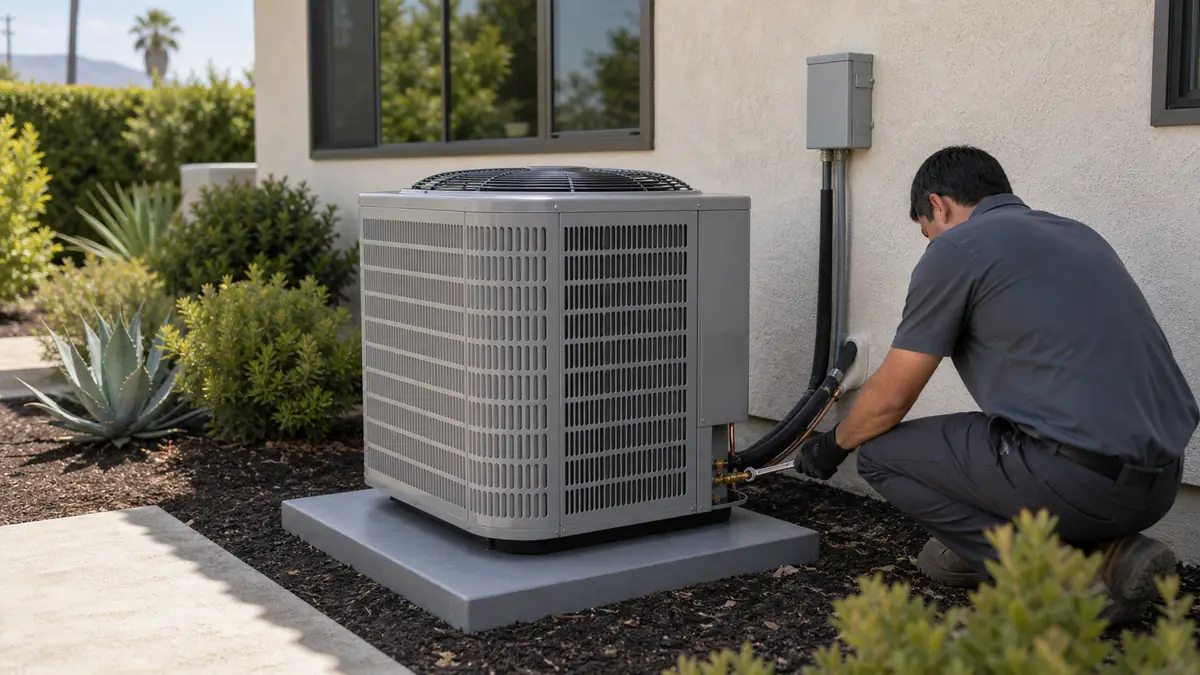
What goes wrong with Trane AC in the Santa Clarita heat?
The valley sits in Title-24 Climate Zone 9, where the Santa Clarita basin traps heat against the surrounding ridges and runs 55 to 75 days a year over 90 F, with Santa Ana spikes past 105 F. That is a brutally cooling-dominant load, and it kills electrical parts before it kills anything mechanical. The single most common no-cool failure we pull off a Trane condenser here is a dual-run capacitor that has dried out and dropped below its microfarad rating, followed by a pitted or welded contactor. Both stop the Climatuff compressor while the rest of the system looks alive. After the electricals, the next tier is refrigerant loss from the all-aluminum Spine Fin coil and condenser-fan-motor failure, both heat-accelerated. On communicating XV systems a comm-bus or board fault can drop a variable-speed unit to single-speed or off entirely.
| Symptom | Likely cause / first check | Cost lane |
|---|---|---|
| Fan spins, compressor silent, warm air | Dead dual-run capacitor or pitted contactor | $150 - $450 |
| Outdoor unit hums, will not start, breaker trips | Capacitor, contactor, or hard-starting Climatuff compressor | $150 - $3,500 |
| Weak cooling, ice on the indoor coil | Low refrigerant leak at Spine Fin coil or a clogged TXV | $225 - $1,500 |
| Condenser fan dead, compressor hot and cycling | Failed condenser fan motor or its capacitor | $300 - $900 |
| XL touchscreen: comm loss / unit runs single-speed | ComfortLink II 4-wire bus or communicating board | $400 - $2,000 |
| Air handler four-flash high-limit, short cycles | Dirty filter or coil starving airflow, not the compressor | $120 - $500 |
How does a Trane AC repair actually go?
Every Santa Clarita no-cool visit moves through the same five checkpoints, cheapest and likeliest first, so what you pay maps to the part we actually find rather than the part we feared. We open by reading the model and serial off the condenser nameplate to date the unit and pull its Trane warranty register status, then walk the system with instruments from there.
- Read the controls. On a communicating XV20i or XV18 the XL850 or XL824 touchscreen shows a plain-language alert (and the same text appears in the Trane Home app), which narrows the job before a panel comes off. A non-communicating XR or XL18i throws no numeric code at all, so we diagnose it electrically from the start.
- Meter the electricals. We clamp the compressor and fan amperage, test the dual-run capacitor's microfarads against the nameplate rating under load, and inspect the contactor for pitting and chatter. A capacitor that reads 5 percent low cold and worse at temperature is the classic Santa Clarita afternoon failure.
- Check the refrigerant side. We gauge suction and discharge pressures against the Spine Fin coil, read superheat and subcooling to the Trane charging chart, and check the temperature split across the registers. Low charge ices the indoor coil and points us to a leak, not a top-off.
- Leak-search before recharging. If the charge is low, we pressure-test and trace with an electronic detector or dye at the flare and braze joints and the coil itself, because a unit that lost refrigerant once will lose it again within days of a blind recharge.
- Quote, fix, and verify. You get a written price on the exact part before any work. After the repair we recover or recharge R-410A by weight if the circuit was opened, recheck subcooling and the temperature split, and confirm the unit holds a full cooling cycle. The instruments that matter are the clamp meter, the digital manifold, the micron gauge, and a leak detector.
Which Trane AC models do you repair, and how do they differ?
The whole residential central-AC range, and the diagnosis changes by tier. The XR-series single-stage units (XR13, XR14, XR15, XR16, XR17, plus the XR16 Low Profile for tight Saugus side yards) are the value workhorses: relay and 24-volt control, full-output or off, and no numeric fault code, so we diagnose them electrically with the capacitor and contactor checked first. The XL18i two-stage runs a two-stage Climatuff and can be wired as a two-stage relay system or communicating, so it sometimes surfaces a plain-language alert and sometimes does not. The variable-speed tier, XV18 (4TTV8/5TTV8) and the flagship XV20i (4TTV0/5TTV0, 2 to 5 ton, up to about 20.5 SEER2), uses an inverter-driven Climatuff and a ComfortLink II communicating board, so a fault usually shows up as text on the XL850 or XL824 rather than a dead unit. Every Trane AC outdoor unit shares the all-aluminum Spine Fin coil, which resists corrosion and has fewer leak points than copper-aluminum fin-tube coils, but is still the surface we leak-search first on a low-charge call. The variable-speed units depend on the communicating thermostat to stage; the XR runs fine on a standard programmable stat.
How do you diagnose a Spine Fin coil leak?
Low charge is a symptom, not a diagnosis, so we never just add refrigerant and leave. After the gauges show the system is short, we isolate the leak: a pressure test with dry nitrogen on the high and low sides, an electronic detector swept across the Spine Fin condenser coil, the brazed and flared line-set joints, the service valves, and the indoor evaporator coil and TXV connections. On the all-aluminum Spine Fin design the common leak points are the U-bends and the joints where the aluminum meets the copper line set, both stressed by years of thermal cycling between 105 F summers and cool valley nights. A flare reseal or a joint braze is an inexpensive fix; a leak in the coil body itself is a coil replacement and a much bigger number, which is exactly where a repair-or-replace conversation starts on an older unit. Once the leak is repaired, we evacuate below 500 microns, hold the vacuum to prove the system is dry and tight, then weigh in the factory R-410A charge and verify subcooling rather than guessing by pressure alone.
What do ComfortLink II faults on an XV system actually mean?
On a variable-speed XV20i or XV18, the XL850 or XL824 touchscreen replaces a blinking outdoor board with plain-language text, and the same alert mirrors into the Trane Home app. "Loss of communication with the outdoor unit" points to the ComfortLink II 4-wire bus, a water-intruded communicating board, or low line voltage at the condenser, not automatically the inverter or the Climatuff compressor. A variable-speed unit that suddenly runs only at single-speed is usually a communication or board fault, not a failed compressor. We meter the bus voltage at the thermostat, the indoor air-handler board, and the outdoor unit to find exactly where the conversation drops, rather than condemning an $800 to $2,000 communicating board on a hunch. For the platform details see the ComfortLink II controls page and the XV20i variable-speed page.
What does Trane AC repair cost in Santa Clarita, and why?
Cost tracks the failed component, not the symptom, and the common failures are the cheap ones. The diagnostic runs about $89 to $200 and is frequently credited toward the repair. From there the lanes stack up. The electrical band is the bulk of summer calls: a dual-run capacitor or contactor is $150 to $450, where the part is $15 to $45 and the rest is the trip and labor. A condenser fan motor and its capacitor run $300 to $900. The refrigerant lane is leak-dependent: a leak search plus an R-410A recharge at roughly $50 to $80 per pound installed lands at $225 to $1,500, cheap for a flare reseal and steep for a coil leak. The expensive band is the communicating side and the compressor: a ComfortLink II or inverter board is $400 to $2,000, and a Climatuff compressor out of warranty is $1,200 to $3,500, skewing high on the variable-speed XV20i. We price the exact part before any wrench turns, and on an aging condenser we add a side-by-side replacement number so the repair-or-replace call is yours to make with both figures in hand. If the math tips toward a new system, the repair-or-replace guide works through the thresholds and the AC installation page covers a right-sized changeout.
What can I safely check before I call?
Two things, both no-tool and no-risk. Replace the air filter if it is gray, because a clogged filter starves the coil, ices it over, and trips the air-handler four-flash high-limit, which mimics a failed compressor. Then clear leaves, cottonwood fluff, and the Santa Ana dust that cakes Santa Clarita condenser fins so the unit can shed heat. Confirm the thermostat is set to cool and not parked in afternoon sun. Stop there. Do not open the outdoor disconnect or meter a capacitor yourself: even with power pulled, a dual-run capacitor holds a stored charge that can shock you, and refrigerant pressures, the contactor, and the compressor are licensed-tech territory under EPA Section 608. If the unit still blows warm after a clean filter and a clear coil, that is the call-a-pro line. Our short-cycling, frozen-coil, and weak-airflow pages walk through the symptoms in more depth.
What about a unit still under Trane warranty?
Trane registered systems carry a multi-year parts warranty, and a covered Climatuff compressor or a communicating board claim should run through a Trane-authorized dealer so you do not pay for a part the factory would replace for free. We will say so on the phone rather than sell you a repair you should get covered. An independent Santa Clarita shop is the right call for everything outside that coverage: a condenser that aged out of its warranty, a fresh look at a quote that leans suspiciously toward a whole new system, retrofits, and any-brand service. Read the independence note on our about page.
Common questions
My Trane AC runs but blows warm air on a 100 F Santa Clarita day. What is it?
Most often a failed dual-run capacitor or a pitted contactor, so the fan spins but the Climatuff compressor never starts. The second suspect in this heat is low refrigerant from a Spine Fin coil leak. We meter the capacitor microfarads and contactor first, then gauge pressures, because a warm-air no-cool is usually a $150 to $450 electrical part, not a compressor.
Why does my AC quit only during the hottest part of the afternoon?
A marginal capacitor reads near spec in the cool morning and drops below its tolerance once the condenser bakes past 3 p.m., so the compressor trips on overload and restarts. High head pressure on a Santa Ana 105 F day does the same. We test the capacitor under load at temperature, not just cold, which is why afternoon-only failures get missed by a quick morning check.
My XV20i shows 'loss of communication with the outdoor unit.' Is the compressor dead?
Usually not. That plain-language ComfortLink II alert points to the 4-wire communicating bus, a water-intruded outdoor board, or sagging line voltage, not the inverter compressor. We meter the bus voltage at the XL850 thermostat, the indoor board, and the condenser to find where the conversation breaks before quoting an $800 to $2,000 board.
How fast can you get to a no-cool call in Santa Clarita during a heat wave?
We triage no-cool calls ahead of routine maintenance and same-week scheduling is normal across the 91350 to 91390 ZIPs, with an after-hours line during a Santa Ana spike past 100 F. Call (213) 755-2539 or book online and tell us the model off the nameplate and whether the outdoor fan is spinning.
Is it worth repairing a 15-year-old Trane condenser, or should I replace it?
It hinges on the part. A capacitor, contactor, or condenser fan motor on a 15-year-old XR is a cheap, sensible fix. A failed Climatuff compressor out of warranty, or any major repair on a unit still running discontinued R-22, tips toward replacement once age times repair cost clears about $5,000. We hand you the repair number and a replacement number the same visit.
My Trane uses R-410A. Can you still get refrigerant for it in 2026?
Yes. R-410A is still produced and stocked for servicing existing systems; the 2025 rule only stops its use in newly manufactured equipment, which now ships with R-454B or R-32. So your installed R-410A Trane is fully serviceable, and we recover, leak-search, and recharge it by weight. We just flag that a new install will be a low-GWP refrigerant, which matters if you are weighing repair against replacement.
Last updated 2026-06-13.