Repair or Replace Your AC in Santa Clarita
Plainly put: Across the Santa Clarita Valley, repair a Trane while the condenser is under 10 to 12 years and the fault is a capacitor or contactor, but replace once a fix tops half a new system or the unit still runs R-22; Santa Clarita Trane HVAC weighs both for you in Valencia (91355), so call (213) 755-2539 or book online. Age times the repair price over $5,000 also says replace.
What to know
- Two gauges: a repair past ~50% of a new system AND a unit past 10-12 years, or age x repair cost over $5,000.
- R-22 manufacturing stopped in 2020; nearly every 1990s-early-2000s valley system is charged with it.
- Typical central AC replacement: $5,000 - $12,000; heat pump install: $6,000 - $16,000.
- The federal 25C credit ended 12/31/2025, so a 2026 install collects nothing from the feds.
- A heat pump may still qualify for SCE or LADWP money; verify the current amounts and program status first.
- Those long Climate Zone 9 cooling hours shorten a higher-SEER2 unit's payback well below any coastal town.
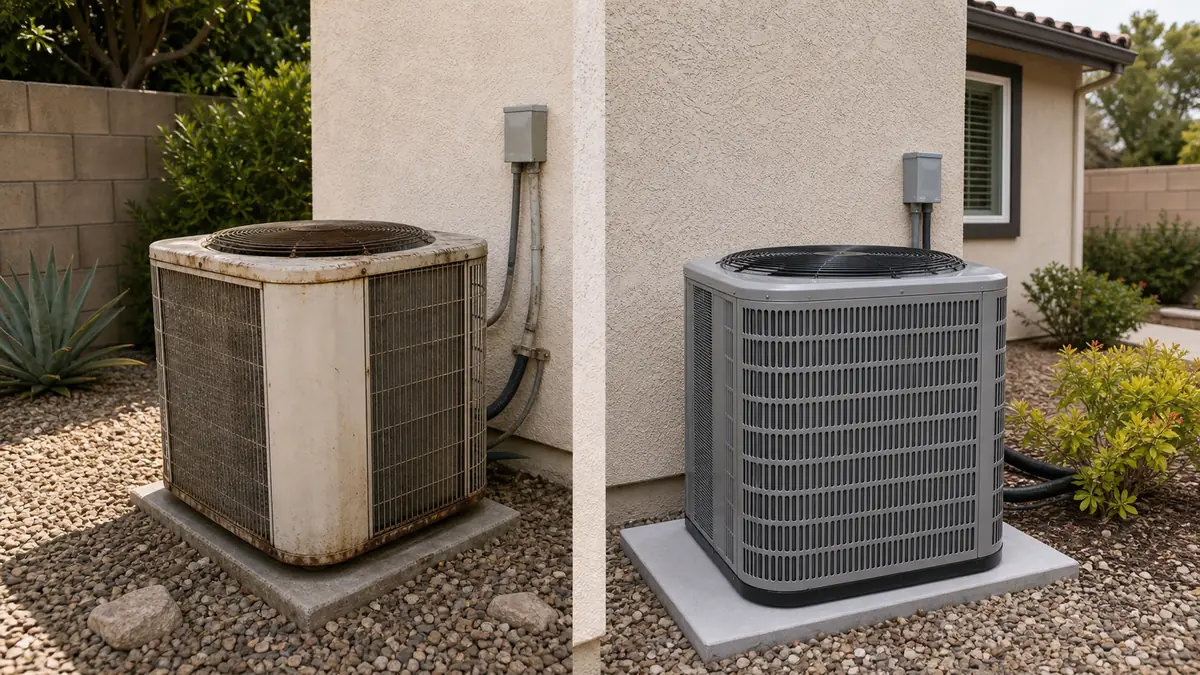
When should I just repair it?
Most service calls end in a repair, and rightly so. If your Trane condenser is under roughly 10 to 12 years old and the failure is a wear part, a dual-run capacitor (150 to 450 dollars), a contactor (150 to 450 dollars), a fan motor, a sensor, or a furnace igniter or flame sensor, repair is almost always the smart money. These parts fail in Santa Clarita's heat regardless of how good the system is, and replacing the whole unit over a 250-dollar capacitor would be throwing away years of remaining life. The Climatuff compressor and Spine Fin coil that anchor a Trane are built to last well past the small parts around them.
| Failure | Why repair | Cost lane |
|---|---|---|
| Dual-run capacitor | Most common valley failure; cheap, fast | $150 - $450 |
| Contactor | Wear part, often paired with capacitor | $150 - $450 |
| Condenser fan motor | Restores cooling on a sound system | $300 - $900 |
| Igniter / flame sensor (furnace) | Common, inexpensive heat fix | $150 - $400 |
When does replacement make more sense?
Once you are into big-ticket parts and a tired system, the numbers flip, and two field gauges point the way. Gauge one: a single repair climbing past about half the cost of a comparable new system on a condenser already beyond 10 to 12 years says replace. Gauge two: multiply the unit's age in years by the repair cost, and a result clearing 5,000 dollars says the same. A failed out-of-warranty Climatuff compressor, 1,200 to 3,500 dollars, bolted to a 16-year-old unit sails past both gauges easily. So does a communicating board stacked on a leaking coil in an already-aging system. We talk that math through with you out loud rather than steering you toward the heavier invoice.
| Situation | Why replace | Cost lane |
|---|---|---|
| Compressor failure, out of warranty, 12+ years | Repair exceeds ~half a new system | $5,000 - $12,000 new |
| R-22 system needs refrigerant work | R-22 scarce and costly since 2020 | Replacement favored |
| Multiple major parts failing together | Age x repair cost over $5,000 | $5,000 - $16,000 new |
| Chronic high bills + weak comfort | Low-SEER unit, long valley run hours | High-SEER2 payback |
Why is so much of Santa Clarita at replacement age now?
Because the valley was built in waves and those waves are aging together. Valencia Summit went up around 1985-1990, the Northbridge tracts through the 1990s, and Tesoro del Valle in the 2000s. The builder-grade condensers fitted to those homes were typically the cheapest qualifying units of their day, and they are now 20 to 35 years old in a microclimate that runs them hard 55 to 75 days a year over 90 F. Most pre-2003 homes here are also still charged with R-22, and manufacturing of that refrigerant halted back in 2020. Stack those three together, worn-out equipment, a discontinued refrigerant, and a brutal cooling load, and you get why Santa Clarita leans install-led instead of repair-led.
Two worked examples from valley driveways
Numbers make the gauges concrete. Both are illustrative composites using typical 2026 SoCal cost bands, not quotes for a specific home.
Example 1, the clear repair. A 7-year-old XR16 in a Canyon Country home loses cooling on a 100 F day; the dual-run capacitor meters low. Repair is about 300 dollars. Run gauge one: 300 dollars is nowhere near half of a 6,500-dollar comparable new system, and the unit is well under 10 years. Gauge two: 7 years times 300 dollars equals 2,100 dollars, under the 5,000-dollar line. Both gauges say repair, and it is not close. Replacing a sound 7-year-old system over a capacitor would throw away a decade of remaining compressor life.
Example 2, the tipping point. A 16-year-old condenser in a Valencia Summit home has a failed, out-of-warranty Climatuff compressor; the repair quote is 2,600 dollars, and the system still runs R-22. Gauge one: 2,600 dollars is roughly 40 to 50 percent of a 5,500-to-6,500-dollar value replacement, and the unit is past 12 years. Gauge two: 16 years times 2,600 dollars equals 41,600 dollars, far past the 5,000-dollar line. Add the discontinued R-22, and every signal points to replacement. Sinking 2,600 dollars into a 16-year-old R-22 system buys you a repaired unit that is still 16 years old on a dead refrigerant.
| Factor | Example 1 (repair) | Example 2 (replace) |
|---|---|---|
| Age | 7 years | 16 years |
| Repair quote | ~$300 capacitor | ~$2,600 compressor |
| Repair vs half a new system | Far under half | Near half, unit past 12 yrs |
| Age x repair cost | $2,100 (under $5k) | $41,600 (over $5k) |
| Refrigerant | R-410A | Discontinued R-22 |
| Call | Repair | Replace |
Does maintenance change the math?
It changes how often you reach the decision at all. In this valley the compressor runs 55 to 75 days a year over 90 F, so the wear parts, the capacitor, contactor, and fan motor, take a beating regardless of brand. A yearly check that cleans the Spine Fin coil, meters the capacitor before it fails mid-heat-wave, tightens the contactor, and verifies refrigerant charge keeps a sound system on the repair side of the line longer and catches a marginal part on a cool spring morning instead of a 105 F afternoon. It does not save a 16-year-old R-22 unit from the eventual changeout, but it does stop a 30-dollar capacitor from cascading into a stressed, overheated compressor. When you do replace, that same discipline protects the new system's warranty, since manufacturers expect documented maintenance.
What about rebates and tax credits in 2026?
Straight talk, and treat every dollar figure here as something to reconfirm before you build a budget on it. The federal 25C Energy Efficient Home Improvement Credit, the heat-pump break worth 30 percent up to 2,000 dollars, was repealed as of December 31, 2025; claims are limited to equipment installed on or before that day, so a 2026 Santa Clarita install draws zero federal 25C credit. Turn to the local programs instead: SCE has reported around 1,000 dollars on a qualifying heat-pump HVAC system, and within the territory it serves, LADWP has listed per-ton incentives that rise with efficiency. TECH Clean California's single-family funding was reported fully reserved statewide early in 2026, with a phased waitlist. SoCalGas aims its rebates at high-efficiency gas furnaces rather than heat pumps. We point you to the official program pages and will not pin a number to your project that may already have shifted.
If I replace, does higher efficiency pay off here?
Far more than it would near the water. The Southwest-region floor pins split ACs under 45,000 BTU at 14.3 SEER2, but Santa Clarita's marathon cooling season means stepping up to a two-stage XL18i or a variable-speed XV20i recovers its premium faster than the identical unit ever could in a gentle coastal climate. Variable-speed operation also softens the start-stop cycling that grinds down capacitors and compressors in our heat. Sizing is the trap: an oversized high-SEER2 unit short-cycles and never delivers the savings printed on the label, which is why every replacement we do starts with a Manual J load. The AC installation page lays out the tiers.
How do we decide with you?
On site, with real numbers. We diagnose the actual fault, price the repair, note the system's age and refrigerant, and if it is borderline we sketch a right-sized replacement so you can compare both figures the same day. No pressure toward the bigger ticket, and a straight answer when a warranty claim belongs with a Trane-authorized dealer instead of us. For specific failures, see short cycling, frozen coil, or our FAQ.
Common questions
What is the 50 percent rule for replacing an AC?
On a valley driveway we read it two ways. If a single repair tops roughly half the price of a comparable new system and your condenser has already racked up 10 to 12 years, a changeout is the smarter spend. The second check backstops the first: take the unit's age in years times the repair quote, and once that figure passes 5,000 dollars, replace. Neither threshold is a hard law, so we put your real Santa Clarita numbers on paper before anyone decides.
Does R-22 refrigerant force a replacement?
No law requires it, but the economics shove you that way. Since R-22 manufacturing wound down in 2020 the stuff is scarce and pricey, so a major repair on an R-22 system frequently runs past what the aging unit is still worth. The bulk of Santa Clarita's 1990s and early-2000s systems carry R-22, which is a big reason so many valley homes have reached replacement age together.
Can I still get the federal heat pump tax credit if I replace in 2026?
For a Santa Clarita changeout dated in 2026, no federal dollars are on the table. The 25C Energy Efficient Home Improvement Credit, that 30-percent-up-to-2,000-dollar heat-pump break, was repealed effective 12/31/2025. The only way to still claim it is on your 2025 return, and only for equipment both purchased and installed by that cutoff date. Lean on the current IRS guidance, then point your effort at the utility programs, since that is the pool that has not dried up.
Is a more efficient system worth it in Santa Clarita?
In our Title-24 Climate Zone 9 valley, yes, and the return beats anything a coastal home would see. Because Santa Clarita stacks up 55 to 75 cooling days above 90 F each year, the compressor puts in long hours, and that workload is precisely what shrinks the payback window on a higher-SEER2 unit. Choose a variable-speed model and you also spare your capacitors the relentless start-stop beating this heat dishes out.
Last updated 2026-06-13.