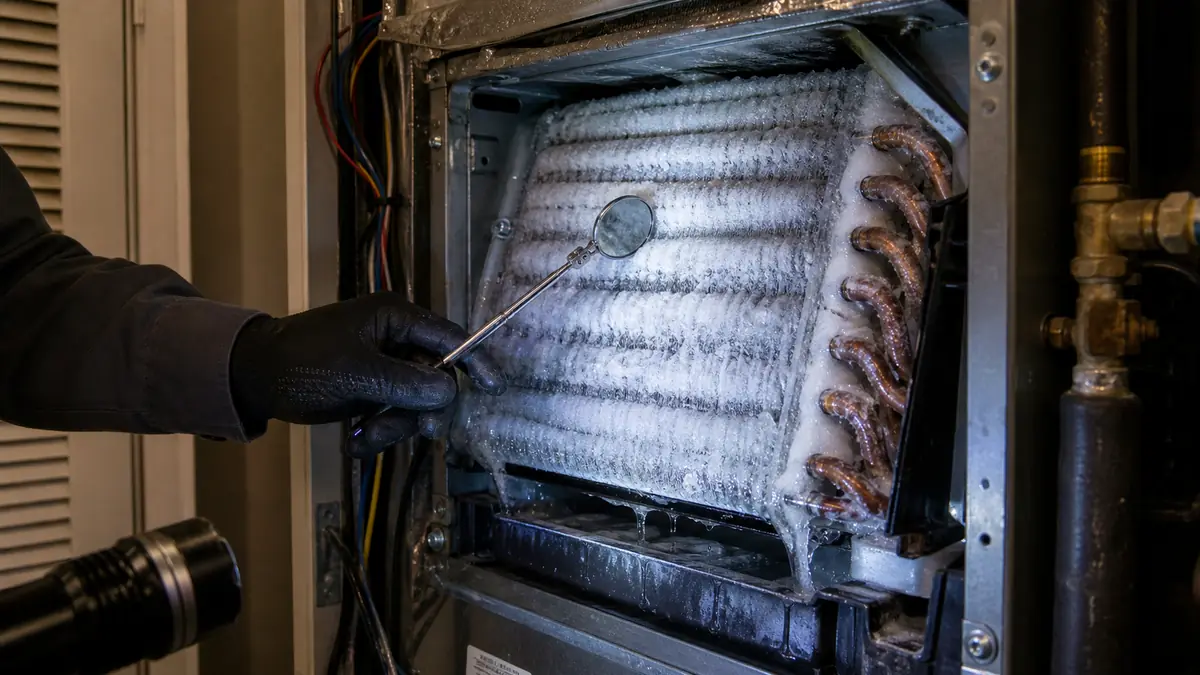
Frozen Evaporator Coil on a Trane in Santa Clarita
Plainly put: A frozen evaporator coil on a Trane in Santa Clarita means the coil is starved of airflow or refrigerant, usually a dirty filter, a failing ECM blower, or a leak; Santa Clarita Trane HVAC diagnoses it across Canyon Country (91387) and Valencia (91355), so call (213) 755-2539 or book online. Switch to fan-only to thaw it, and do not keep running a frozen system or you risk a $1,200 compressor.
What to know
- Freezing comes from poor heat absorption, not cold weather; it happens worst on hot, humid days.
- Top causes: clogged filter, dirty evaporator coil, failing ECM blower, low refrigerant.
- Running a frozen system risks liquid slugging the compressor; switch to fan-only.
- Filter / airflow fix: $120 - $500; refrigerant leak repair + recharge: $225 - $1,500.
- Diagnostic $79 - $200, often credited toward the repair.
- Independent; coverage ZIPs 91350-91390.
Why does a coil freeze in the Santa Clarita heat?
The evaporator coil gets cold by absorbing heat from the air moving across it. When that airflow drops, or the refrigerant charge falls, the coil temperature sinks below 32 F and the humidity in the air freezes onto it. So the worst freezes happen on the hottest, most humid afternoons, exactly when you need the system most. A clogged filter is the most common trigger in valley homes that skip filter changes through the long cooling season, followed by a tired blower motor and a slow refrigerant leak.
| Clue | Likely cause / first check | Cost lane |
|---|---|---|
| Filter visibly dirty, thaws and runs fine | Clogged filter starving airflow | $120 - $250 |
| Refreezes with a clean filter | Dirty evaporator coil or failing ECM blower | $300 - $2,300 |
| Weak cooling, hissing, refreezes | Low refrigerant from a leak | $225 - $1,500 |
| Water around the air handler after thaw | Overflowed pan / clogged condensate drain | $150 - $450 |
What should I do before the tech arrives?
Turn the cooling off and set the fan to ON so the blower thaws the coil; this can take an hour or more on a fully iced system. Replace a dirty filter while you wait. Do not chip at the ice or run cooling to force it, because pushing liquid refrigerant back to the Climatuff compressor is how a 200-dollar airflow problem becomes a compressor job. Once thawed, we can read pressures and airflow accurately.
How do we find the real cause, step by step?
After the coil thaws, we diagnose airflow first because it is the most common and cheapest cause, then move to refrigerant:
- Inspect the filter and coil face for dust loading, and check the return for the undersized ducting common in two-story valley tract homes.
- Measure total external static pressure across the air handler against the blower rating. High static with a clean filter means the coil or ducts are choking flow.
- Test the ECM blower directly. A failing variable-speed module can move too little air while the furnace LED still shows a normal call, so the board may not flag it.
- If airflow checks out, gauge the refrigerant charge against the Spine Fin coil and read superheat and subcooling. Low charge, not weather, is what drives the coil below 32 F.
- Leak-search with electronic detection or dye at the flare and braze joints, then repair and recharge. A coil that froze from low charge refreezes within days of a top-off, so we never just add refrigerant.
Are there fault codes for a frozen Trane coil?
Not a dedicated freeze code on the common units. A non-communicating XR or XL throws no numeric code, so we diagnose airflow and charge electrically and by gauge. The clue that does show up is the furnace or air-handler integrated control LED flashing four times, the open-high-limit code, when low airflow lets the heat exchanger or coil section overheat. On a communicating XV20i the XL850 or XL824 surfaces a plain-language airflow or low-charge alert in the Trane Home app, which speeds the call. Either way, the freeze itself is a symptom we trace back to airflow or refrigerant.
What does a frozen coil cost to fix in Santa Clarita?
The cheap end is the usual end. A filter and airflow correction runs 120 to 500 dollars. A dirty evaporator coil clean or a failing ECM blower spans 300 to 2,300 dollars, with a variable-speed ECM module at the high end. A refrigerant leak repair plus recharge is 225 to 1,500 dollars, driven by where the leak sits and how much R-410A the system lost at roughly 50 to 80 dollars a pound installed. A clogged condensate drain that overflowed during the thaw is 150 to 450 dollars. The diagnostic is 79 to 200 dollars and is often credited toward the repair.
How a frozen coil ties into the rest of the system
A freeze rarely stands alone. The same low airflow that ices the coil also shows up as weak airflow at the registers, and a low charge that frosts the coil will also drive short cycling as the system trips on protection. A leak repair is routine heat pump and AC repair work, and chronic airflow trouble often points back to the duct sealing that two-story Tesoro del Valle and Valencia homes frequently need.
Common questions
Why does my coil freeze when it is 100 degrees outside?
Counterintuitive, but freezing comes from poor heat absorption, not cold weather. A dirty filter, a failing blower, or low refrigerant drops the coil temperature below freezing, and the moisture in the air ices it solid. The hotter and more humid the day, the faster a starved coil frosts over.
Should I keep running the AC if the coil is frozen?
No. Running a frozen system pushes liquid refrigerant back toward the compressor, which can damage it. Switch the system to fan-only to thaw the coil, then call for a diagnosis. Forcing it in Santa Clarita's heat risks turning a cheap airflow fix into a compressor replacement.
Will changing the filter fix a frozen coil?
Sometimes that is the whole problem. A clogged filter starves the coil of airflow and is the most common, cheapest cause. If a fresh filter and a thawed coil run normally, you are done. If it refreezes, the cause is deeper: a failing ECM blower, a closed-up coil, or a refrigerant leak.
How do you find the leak if it is low on refrigerant?
We confirm the charge against the Spine Fin coil, then leak-search with electronic detection or dye. Trane's all-aluminum coil has fewer leak points than older copper designs, but flare and braze joints still leak. We repair and recharge rather than just topping it off, since a top-off only delays the next freeze.
Last updated 2026-06-13.