Why Your AC Is Making Noise in Santa Clarita
Plainly put: A noisy AC in Santa Clarita has a vocabulary: buzzing is usually a contactor or capacitor ($150-$450), screeching is a fan motor bearing, hissing is often a refrigerant leak; Santa Clarita Trane HVAC reads each across Saugus (91350) and Canyon Country (91387), so call (213) 755-2539 or book online. A loud electrical buzz or hard clank means shut it off before it damages the compressor.
What to know
- Buzzing / humming: failing contactor or dual-run capacitor, $150 - $450.
- Screeching: condenser fan motor bearing, often a $300 - $900 motor swap.
- Rattling / clanking: loose hardware or debris, sometimes a serious compressor fault.
- Hissing / bubbling: refrigerant leak, repair + recharge $225 - $1,500.
- Valley dust and Santa Ana winds drop debris into outdoor units regularly.
- Independent; coverage ZIPs 91350-91390.
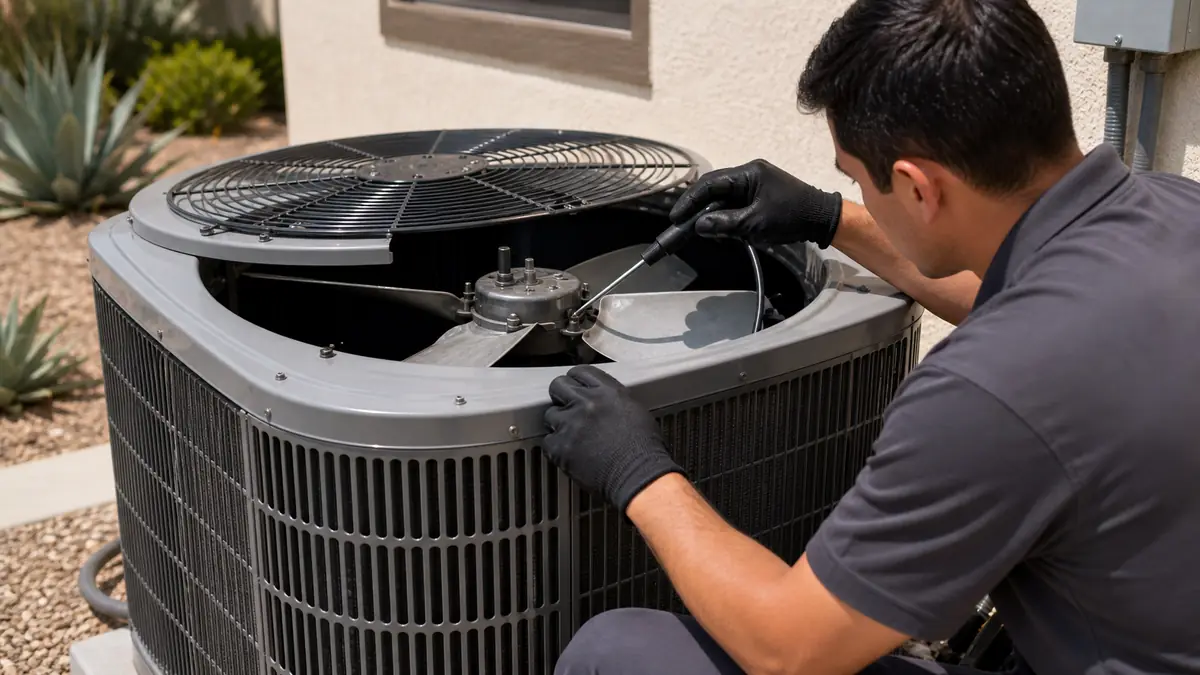
What does each AC sound mean?
Sounds are diagnostic clues before we even open the unit. An electrical buzz or hum at the condenser points to the contactor or capacitor, the two parts that fail most in Santa Clarita's heat, and a unit stuck humming without spinning is a classic capacitor failure. A screech is a bearing, usually the condenser fan motor. A rattle is loose hardware or debris kicked in by valley wind. A hiss or gurgle is refrigerant. A hard, repetitive clank from the compressor is the one that worries us. Use the table to translate.
| Sound | Likely cause / first check | Cost lane |
|---|---|---|
| Loud buzz / hum, fan or compressor won't start | Failing contactor or dual-run capacitor | $150 - $450 |
| Screech / squeal at startup | Condenser fan motor bearing | $300 - $900 |
| Rattle / vibration | Loose panel, hardware, or debris in the unit | $100 - $400 |
| Hiss / bubbling, weak cooling | Refrigerant leak near Spine Fin coil / joints | $225 - $1,500 |
| Hard clank / banging from compressor | Internal compressor damage | $1,200 - $3,500 |
Which noises mean shut it off now?
Two. A loud electrical buzz where the unit hums but the fan or compressor will not spin can overheat the Climatuff compressor within minutes, so kill the power and call. A hard, repetitive clank or banging from the compressor itself signals possible internal damage; running it makes it worse. A mild rattle or a brief startup screech is less urgent but still worth a same-week look before a bearing seizes. When in doubt, shut it down rather than risk turning a motor or capacitor job into a compressor replacement.
How do we track down the source, step by step?
We localize the sound first, then meter the suspect part, because the same buzz can be a 30-dollar capacitor or a failing compressor:
- Isolate the location: condenser outside, air handler or furnace inside, or the duct. Killing power to the outdoor unit while the blower runs tells us instantly whether the noise is electrical or airside.
- At a buzzing condenser, meter the dual-run capacitor's microfarads and inspect the contactor for pitting and chatter. A unit humming without spinning is the textbook capacitor or contactor failure.
- For a screech, spin the condenser fan motor by hand (power off) to feel for a dry or rough bearing before it seizes.
- For a rattle, check panel screws, the fan shroud, and the cabinet base for the Santa Ana dust, gravel, and cottonwood debris valley units collect.
- For a hiss or gurgle, leak-search the Spine Fin coil and the flare and braze joints, then gauge the charge.
- For a hard clank from the compressor, read amp draw and listen for internal knock; that is the one that decides repair-versus-replace.
Do these noises throw a Trane fault code?
Mostly no, which is why the sound itself is the diagnostic. Non-communicating XR and XL condensers carry no numeric code, so a buzz, screech, or hiss is read electrically and by gauge. A communicating XV20i can surface a related plain-language alert on the XL850 or XL824, for example a loss-of-communication or outdoor-unit fault, but it will not name the bearing or the leak. Inside, if low airflow from a noisy or failing blower overheats the heat exchanger, the furnace control LED flashes four times for an open high-limit. We pair any code with what we hear and meter.
Which noises are safe to wait on, and which are not?
Safe to schedule, not panic: a faint startup squeal or a mild rattle usually means a bearing or a loose panel caught early, worth a same-week visit before it worsens. Shut it off now: a loud electrical buzz where the unit hums but will not start can cook the Climatuff compressor within minutes, and a hard, repetitive clank from the compressor signals possible internal damage that running only deepens. You can safely clear visible debris and tighten an obvious loose panel screw with the disconnect pulled; do not open the electrical compartment or touch the capacitor, which holds a shock-capable charge even with power off.
What do these repairs cost in Santa Clarita?
The common noises are the affordable fixes. A buzzing capacitor or contactor is 150 to 450 dollars installed. A screeching condenser fan motor is roughly 300 to 900 dollars. A rattle from loose hardware or debris is often 100 to 400 dollars. A hissing refrigerant leak repair plus recharge runs 225 to 1,500 dollars. The expensive outlier is the clanking compressor at 1,200 to 3,500 dollars, which on an aging out-of-warranty unit usually tips into a replacement decision. The diagnostic is 79 to 200 dollars and is often credited toward the repair.
How do these noises connect to other problems?
A noisy condenser rarely stands alone. A failing capacitor that buzzes also drives short cycling in the afternoon heat, and a hiss that signals low charge often shows up next as a frozen coil. A fan motor or capacitor swap is routine heat pump and AC repair work, and a worn blower that whistles or rattles can point back to duct and return restrictions.
Common questions
My Trane condenser is buzzing loudly. Is that dangerous?
A loud electrical buzz at the condenser is often a failing contactor chattering or a capacitor on its way out, sometimes with the fan or compressor straining to start. It can leave the unit stuck humming without running. Shut it off and call; running it that way overheats the Climatuff compressor.
What is the screeching sound when my AC starts?
A high-pitched screech at startup usually points to a failing fan motor bearing or, on older belt-driven air handlers, a worn belt. On modern Trane ECM systems it is typically the condenser fan motor bearing. Caught early it is a motor swap; ignored it can seize and burn out.
Why does my system rattle or clank?
Rattling is usually loose hardware, a panel, or debris in the condenser; valley dust storms and Santa Ana winds drop plenty into outdoor units. A hard clank or banging from the compressor is more serious and can mean internal damage. We separate cheap cosmetic rattles from a failing compressor.
Is a hissing sound a refrigerant leak?
It can be. A steady hiss or bubbling often signals refrigerant escaping, frequently at a flare or braze joint near the Spine Fin coil. A loud hiss with weak cooling deserves a prompt leak search, since running low on charge can ice the coil and stress the compressor.
Last updated 2026-06-13.