Trane Furnace Repair in Santa Clarita
Plainly put: Santa Clarita Trane HVAC repairs Trane furnaces across Santa Clarita, including Valencia (91355) and Newhall, reading the integrated furnace control LED flash codes and fixing igniters, flame sensors, inducers, and pressure switches. Call (213) 755-2539 or book online; most no-heat calls land at $150 to $400. We service S-series, XV95, XC95m, and the common 80% XL80/XR80 units, with an honest repair-or-replace call.
What to know
- Most no-heat calls: flame sensor or hot-surface igniter, roughly $150 - $400.
- Inducer motor, pressure switch, or gas valve: mid hundreds depending on part.
- Control board: $400 - $900; full furnace replacement: $3,000 - $7,500.
- We read the IFC LED flash code (2 = lockout, 3 = pressure, 4 = high-limit, 8 = flame sense).
- Units served: XC95m, XV95, S9V2, S9X2, and 80% XL80/XV80/XR80.
- Independent; in-warranty parts referred to Trane authorized service.
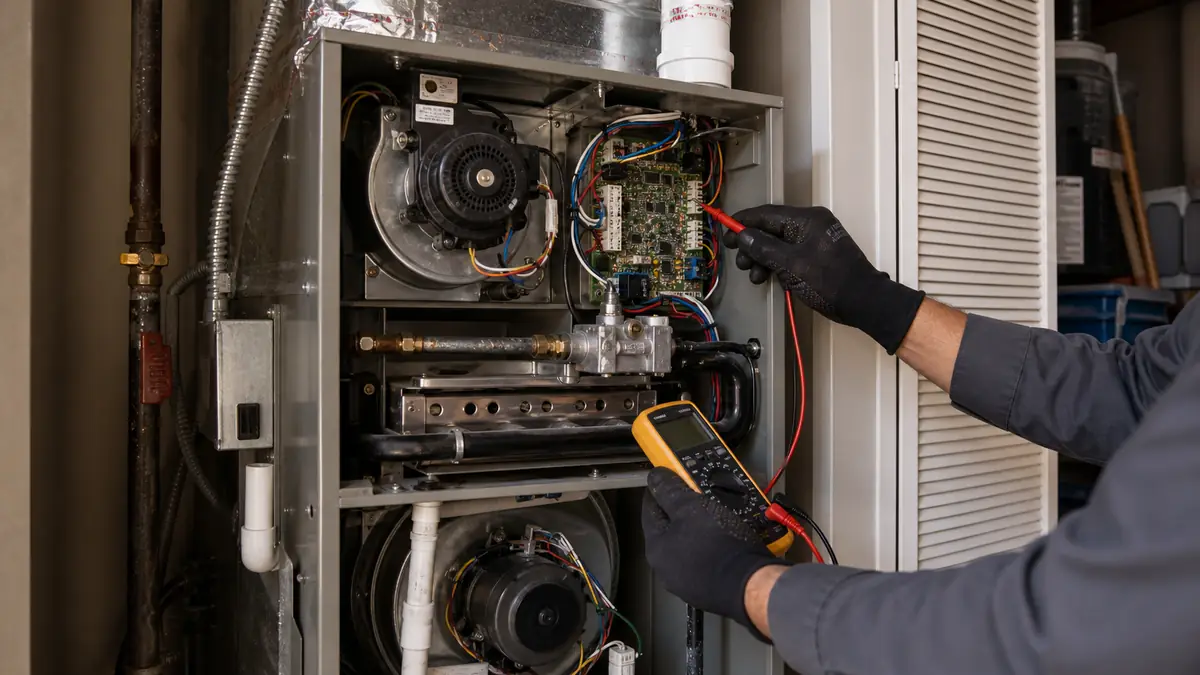
What breaks on Santa Clarita furnaces?
In this valley the furnace sits idle through a long, hot cooling season, then gets asked to fire on the first chilly Newhall or Canyon Country morning. That idle stretch is exactly why the early-winter rush is dominated by dirty flame sensors and tired igniters rather than dramatic failures. Trane furnaces flash a fault code on the integrated control LED, which tells us where to look before we pull a single screw.
| LED flashes | Meaning / first check | Cost lane |
|---|---|---|
| 2 flashes | System lockout: ignition retries exceeded; check igniter and flame sensor | $150 - $450 |
| 3 flashes | Vent / pressure-switch error: inducer, blocked flue, or switch | $200 - $600 |
| 4 flashes | Open high-limit: overheating, dirty filter, low airflow | $120 - $500 |
| 5 flashes | Flame sensed with no call: gas-valve leak-by or board | $300 - $900 |
| 6 flashes | Reversed 115V polarity or poor grounding | $150 - $400 |
| 7 flashes | Gas valve circuit error | $300 - $800 |
| 8 flashes | Low flame-sense signal: dirty flame sensor | $150 - $300 |
| 9 flashes | Igniter circuit / line-to-24V common voltage fault | $200 - $600 |
How do you diagnose a no-heat call?
We start at the control board. The status LED gives the flash code, then we verify: igniter resistance and glow, flame-sense microamps, inducer operation and pressure-switch closure, and the high-limit. A four-flash high-limit trip is usually airflow, a clogged filter, or a dirty blower, not a bad limit switch, so we chase the cause rather than swap the symptom. If we see a five-flash code, flame sensed when none should be present, we treat the gas valve and board carefully because that points to a leak-by.
How do you check a furnace heat exchanger for cracks?
Carefully, because a compromised heat exchanger is the one furnace fault that turns from comfort problem into safety call. After a long Santa Clarita cooling season the furnace has sat idle, and the first hard heating run can expose a crack that opened from years of thermal cycling. We visually inspect the exchanger with a borescope where access allows, watch the burner flame for the rollout or flutter that a crack causes when the inducer runs, and check for a six- or rollout-related code. A rollout switch that has tripped is a red flag that points straight at the exchanger. If we confirm a crack, we red-tag and shut the unit down rather than patch it, because a cracked exchanger can let combustion byproducts into the supply air. That is the point where a $3,000 to $7,500 furnace replacement, or a heat-pump conversion, replaces the repair conversation entirely. We never gamble on a safety component.
Which Trane furnaces do we work on here?
The full residential range, from the budget 80% tier up to the modulating flagship. The 80% AFUE units, the XL80, XV80, and XR80, are the most common thing we see in Santa Clarita, because in this mild-winter climate 80% is frequently adequate and was the cheap builder default. Above that sit the 95-96% single-stage value furnaces (S9X1, XR95), the two-stage S9X2 with a constant-torque ECM and the S9V2 two-stage with a variable-speed ECM blower (up to ~96% AFUE), the variable-speed XV95 (~97%), and the modulating XC95m (up to ~97.3% AFUE) that pairs a modulating gas valve with a variable-speed ECM for the steadiest heat. The repair work changes with tier: the 80% units are mostly igniter, flame sensor, inducer, and pressure-switch jobs, while the variable-speed and modulating units add ECM blower and communicating-board diagnosis. We read the integrated furnace control LED on all of them.
What does furnace repair cost in Santa Clarita, and why?
Most no-heat calls land between $150 and $400, because the usual suspects, a dirty flame sensor or a cracked hot-surface igniter, are inexpensive parts. The cost climbs with the part: an inducer motor or pressure switch runs into the mid hundreds, a gas valve $300 to $800, and a control board $400 to $900. The diagnostic itself is about $89 to $200 and is frequently credited toward the repair. A variable-speed ECM blower module on an XV95 or XC95m sits at the high end, $450 to $2,300, because the motor and module are pricier than a PSC blower. Where the math tips is a compromised heat exchanger: that is a safety condemn, and on an aging 80% furnace already paired with a tired condenser, a $3,000 to $7,500 furnace replacement, or a heat-pump conversion, usually beats stacking repairs. We give you the part price before any work and add a replacement number when the unit warrants it.
When should a furnace be replaced, not repaired?
A six-flash polarity issue or a single failed igniter is a repair. Replacement enters the conversation on a cracked or rolled-out heat exchanger (a safety call, often tied to a rollout switch), or when the inducer, board, and gas valve are failing together on an old unit. Many valley homes pair an aging 80% furnace with an aging condenser, in which case replacing both, or converting to a heat pump, can beat patching each. Our repair-or-replace guide covers the math.
Common questions
What do the flashing lights on my Trane furnace board mean?
The integrated furnace control flashes a fault code through a status LED. Two flashes is a system lockout, three is a pressure-switch or inducer issue, four is an open high-limit from overheating or low airflow, and eight is weak flame sense from a dirty flame sensor. We read the code through the inspection window before pulling parts.
Why won't my furnace ignite on the first cold Santa Clarita morning?
After sitting idle all summer, the most common no-heat call is a dirty flame sensor or a cracked hot-surface igniter. Dust and a touch of corrosion build up over the long cooling season. Both are quick, affordable fixes once we confirm the LED code and meter the igniter resistance.
Is it worth repairing an 80 percent furnace?
Often yes. The 80% AFUE tier is common and adequate across mild SoCal, so a 150 to 400 dollar igniter or flame-sensor repair on a sound 80% furnace is sensible. We flag replacement only when the heat exchanger is compromised, the inducer and board both fail, or the unit is paired with a dying condenser worth replacing together.
Do you repair furnaces under Trane warranty?
If the board, gas valve, or heat exchanger is a covered part, a Trane-authorized dealer should handle that claim. We will tell you when it applies. Out of warranty, or for a second opinion on a red-tagged unit, we do the full repair. Call (213) 755-2539.
My furnace short-cycles on heat. Is that the furnace or the airflow?
Most often airflow. A dirty filter, an undersized return, or a closed-up duct system overheats the heat exchanger and trips the high-limit, which shows as a four-flash code and rapid on-off cycling. We check static pressure and the filter before condemning the limit switch, since the limit is usually doing its job, not failing.
Why does my furnace smell like dust when it first fires each fall?
That is dust burning off the heat exchanger and burners after a long Santa Clarita cooling season with the furnace idle, and it usually clears within a few minutes of the first few runs. If the smell is sharp, electrical, or persistent, shut it down and call us, because that can signal a wiring or board fault rather than harmless dust.
Last updated 2026-06-13.